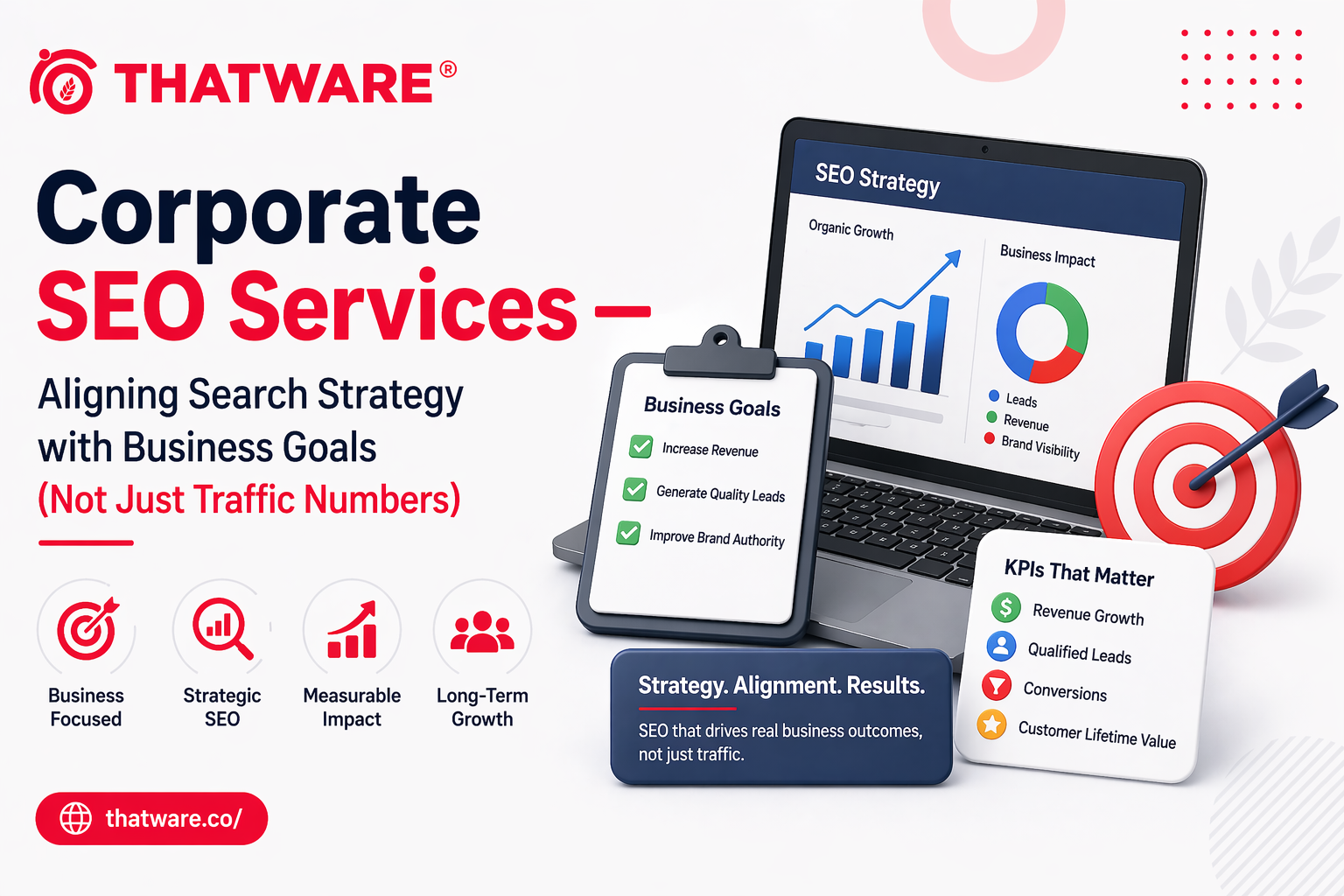
There’s a reporting problem that lives inside most enterprise SEO relationships, and it’s surprisingly widespread. The agency sends over a monthly deck. Rankings are up. Organic sessions are growing. Everyone nods along. And then someone in the room asks whether any of that traffic actually converted into revenue, and things get a little quieter.
Traffic is easy to optimize for. Business outcomes are harder. And the gap between those two things is where a lot of corporate SEO investment quietly disappears.
This isn’t about blaming agencies. It’s about recognizing that SEO strategy at the enterprise level needs to be built around business goals from the very beginning, not retrofitted onto a keyword report after the fact.
The Scale Problem Nobody Talks About Enough
Enterprise SEO is fundamentally different from small business SEO, not just in budget but in complexity. A company with ten thousand product pages, multiple business units, content in several languages, and a development team that has its own sprint cycle faces a completely different set of challenges than a single-location service business.
The coordination layer alone is significant. Getting technical SEO recommendations actually implemented requires navigating internal processes, convincing engineering teams, sometimes going through legal review. The work isn’t just identifying what to fix. It’s knowing how to get things fixed inside a large organization, which requires a different kind of expertise than pure search knowledge.
Add to that the content dimension. Enterprise businesses often have enormous content libraries that are partially optimized, partially outdated, and partially cannibalizing each other. Content governance at scale is a real operational challenge, not just an SEO one.
A competent corporate seo services partner understands that their job is as much about organizational alignment as it is about technical execution.
Connecting Search Strategy to What the Business Actually Cares About
This sounds obvious but it’s done badly more often than not. SEO strategy for a B2B SaaS company should look different from SEO strategy for a retail enterprise. The keywords, the content types, the conversion paths, the success metrics, all of these should be derived from business objectives, not the other way around.
If the business goal is expanding into a new vertical, SEO strategy should be building topical authority and organic visibility in that vertical, not just growing overall traffic. If the goal is increasing customer lifetime value by promoting certain product categories, SEO should be strengthening the pages and content that support that journey.
This alignment doesn’t happen automatically. It requires the SEO team to understand the business well enough to translate strategic priorities into search tactics. And it requires stakeholders on the business side to be invested in the process rather than treating SEO as a separate marketing channel that operates in its own silo.
The Technical Depth Required
At the enterprise level, technical SEO can get genuinely complex. JavaScript rendering at scale. International SEO with hreflang implementations across multiple domains or subfolders. Log file analysis to understand crawl budget allocation across a site with millions of URLs. Core Web Vitals optimization for pages that are built by multiple teams using different tech stacks.
Getting this right consistently, across a large site with ongoing development activity, requires a level of technical rigor that goes beyond most generalist agencies. The people doing this work need to understand how search engines actually process content, not just what best practices say to do.
Enterprise seo services at the level required by large organizations involves ongoing technical monitoring, not just a one-time audit. Sites change constantly, and the things that were working three months ago can break without anyone noticing until rankings start moving in the wrong direction.
Measuring What Actually Matters
The reporting question is worth returning to, because this is where the business alignment actually gets tested.
Good enterprise SEO measurement goes beyond sessions and rankings. It tracks organic-assisted revenue, qualified lead contribution from organic, revenue per organic session by category, share of voice in target keyword clusters, and movement against specific business objectives. These metrics require more setup and more cross-functional collaboration than a standard analytics dashboard, but they’re the ones that actually tell the story of whether the investment is working.
When SEO can show its contribution to pipeline, to revenue, to market position in specific segments, it becomes a strategic business function rather than a marketing cost. That shift in perception matters for budget, for resource allocation, and for the kind of cross-functional cooperation that actually enables SEO work to get done inside large organizations.
Patience and Momentum
One thing that rarely gets enough air time in enterprise SEO conversations is the timeline expectation setting that needs to happen at the beginning of an engagement. Large sites with complex technical debt don’t transform overnight. The first few months of any serious enterprise engagement are often dominated by audit work, recommendation development, and the sometimes slow process of getting those recommendations into a development queue.
That doesn’t mean nothing is happening. It means the foundation is being built. The businesses that see the biggest organic returns over a two to three year horizon are usually the ones that committed to doing the foundational work properly rather than looking for quick wins that might look good in a deck but don’t build lasting positions.
Search strategy and business strategy should be the same conversation. At scale, that alignment is the thing that separates meaningful organic growth from activity that looks busy but doesn’t move the needle.